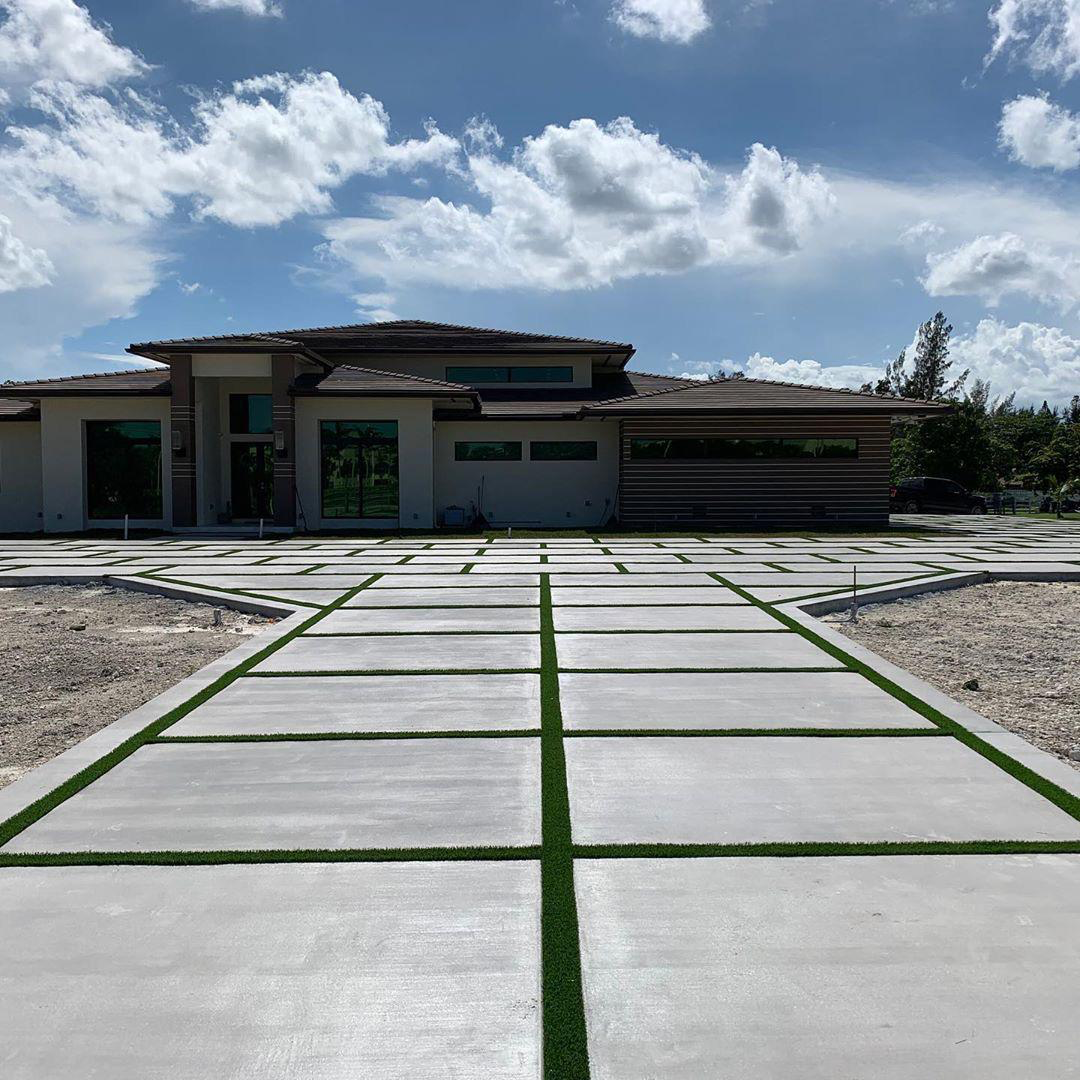
Short answer: A plain broom-finish concrete driveway typically runs somewhere around $6 to $12 per square foot installed in the Florida market, which puts a standard two-car driveway of roughly 600 square feet in the region of $3,600 to $7,200. Decorative finishes like stamped or exposed aggregate typically run higher, often $12 to $25 per square foot. Those are typical market ranges rather than quotes. What actually moves your number is the sub-base prep, the thickness and reinforcement, whether an old slab has to come out, and site access.
The frustrating thing about researching this is that every source gives you a different number, and none of them can tell you what your driveway costs, because most of the price is decided by things a website cannot see.
So rather than pretend otherwise, here is what actually changes the figure, and what to look for when you compare quotes.
What you are actually paying for
A driveway is not a slab poured on dirt. Roughly, the money goes into:
- Site prep and excavation. Clearing, grading, and getting the ground to the right level
- The sub-base. Compacted base material underneath the concrete
- Forming. Building the edges that shape the pour
- Reinforcement. Wire mesh or rebar, depending on the spec
- The concrete itself. Material, delivery, and the pour
- Finishing. Screeding, floating, the surface texture, and the control joints
- Curing and cleanup
On a straightforward job the concrete material is a smaller share of the total than most people expect. Labor and preparation are where the cost lives.
What actually moves the price
| Factor | Effect on cost |
|---|---|
| Square footage | The obvious one, though larger pours often cost slightly less per square foot |
| Removing an old driveway | Adds meaningfully. Demolition, hauling and disposal are real line items |
| Thickness | 4 inches is standard residential. 5 to 6 inches for heavy vehicles or an RV pad costs more |
| Reinforcement | Wire mesh is cheaper than a rebar grid. Rebar is worth it for heavier loads |
| Sub-base work | The big variable in Florida. Poor or sandy soil needs more base and more compaction |
| Finish | Broom finish is the baseline. Stamped, stained, exposed aggregate all cost more |
| Site access | If the truck cannot get close, concrete has to be moved by other means, and that adds labor |
| Slope and drainage | A driveway that needs grading work, a swale, or drainage costs more than a flat pour |
| Permits and the apron | Work in the public right of way is a separate approval, often a separate cost |
| Shape | Curves, flare-outs and turnarounds take more forming labor than a rectangle |
The Florida factors that catch people out
Three things here differ from a general national cost guide.
Sandy soil and the sub-base. Much of the Tampa area sits on sand. Sand drains beautifully and compacts poorly if it is not done properly. A driveway poured over an inadequately prepared base will crack and settle regardless of how good the concrete is. This is the single most common place a cheap quote is cheap, and it is invisible once the slab is down. When you compare quotes, compare the base prep before you compare the price.
Water. A high water table, heavy summer rain, and the need to not dump runoff onto a neighbor’s property all shape the design. Grading and drainage are not decoration on a Florida driveway.
Heat and curing. Concrete does not dry, it cures, and it is a chemical reaction that runs fast when it is hot. A slab poured in a Florida August that is not properly cured loses strength and is more likely to crack. Proper curing costs a little time and attention, and skipping it is free right up until it is not.
Permits and the apron. The apron is the section where your driveway meets the road, and it usually sits in the public right of way. In Hillsborough County and the City of Tampa that portion generally involves a separate permission from the driveway itself, and requirements vary by municipality. A contractor who handles this as part of the job is saving you a genuine headache, and one who does not mention it at all is worth asking.
Where quotes legitimately differ
Two quotes on the same driveway can differ substantially and both be honest. Common reasons:
- One includes demolition and one does not. Always check
- Different thickness or reinforcement spec. A 4-inch mesh slab and a 6-inch rebar slab are different products
- Different base preparation. The most consequential difference and the least visible
- Concrete strength. Mixes are specified by PSI, and a higher-strength mix costs more
- Whether the apron and permit are included
- Warranty. Concrete cracks, that is its nature, but what the contractor will and will not come back for varies a lot
What is not a legitimate difference: skipping the control joints, pouring over an unprepared base, or a quote so far below the others that something has been left out. If one number is dramatically lower, the useful question is not “why are you cheaper” but “what is in the others that is not in yours.”
What makes a driveway last
Concrete is going to crack somewhere. The goal is controlling where.
- Control joints are cut or tooled in deliberately so the slab cracks along a straight line you chose rather than randomly across the middle. A driveway without them is a driveway that will crack unattractively
- Proper base compaction stops settlement, which is what causes the ugly stepped cracks
- Adequate thickness for the actual load. If a heavy truck or an RV will park on it, say so before the quote, not after
- Curing. Especially in Florida heat
- Sealing is optional and opinions vary, but it helps with staining, which matters more on decorative finishes
Straight or decorative
Broom finish is the standard, it is the least expensive, and it has good traction wet, which is not nothing in a state that rains every afternoon in summer.
Stamped and colored concrete costs more per square foot but changes how the front of a house reads, and it is a lot less expensive than pavers for a similar look. It does need more maintenance, mainly resealing, and a stamped surface can be slicker than a broom finish when wet.
Neither is the right answer universally. It depends on whether the driveway is a utility or part of the front elevation.
Getting a number you can rely on
The only figure that means anything is one from someone who has stood on your driveway. What you can do to make that quote accurate:
- Measure roughly. Length by width gets you a square footage that makes conversations concrete
- Decide about the old slab. Is it coming out, or is this a new pour on undeveloped ground
- Know what will park there. Two cars is different from a work truck and a boat trailer
- Ask what base prep is included, in writing, in every quote
- Ask who handles the permit and the apron
- Get it all in writing, including thickness, reinforcement, PSI, joint layout and warranty
All Phase Concrete works across Tampa and the surrounding Florida market on concrete driveways and the rest of our residential concrete services. Estimates are free, and we would rather walk you through why a number is what it is than hand you a figure with no explanation behind it.
Frequently asked questions
How much does a concrete driveway cost in Florida?
Typical market ranges run roughly $6 to $12 per square foot for a standard broom-finish driveway, and $12 to $25 per square foot for decorative finishes such as stamped or exposed aggregate. A standard two-car driveway of about 600 square feet therefore commonly lands somewhere between $3,600 and $7,200 plain. These are general market ranges, not a quote, and the real figure depends on your site.
Is concrete cheaper than pavers for a driveway?
Generally yes, plain concrete costs less installed than pavers. Stamped concrete sits between the two, giving a decorative look for less than pavers. Pavers have the advantage that individual units can be lifted and replaced, while concrete repairs are more visible.
How thick should a concrete driveway be?
Four inches is the standard for ordinary residential vehicles. Five to six inches is normal where heavier vehicles will park, such as an RV, a boat trailer, or a work truck. Tell your contractor what will actually use the driveway before the quote, because thickness is not something to change later.
Do I need a permit for a driveway in the Tampa area?
Usually yes, and the section where the driveway meets the road generally needs a separate approval because it sits in the public right of way. Requirements differ between the City of Tampa, Hillsborough County and the surrounding municipalities, so confirm who is pulling what before work starts.
How long before I can drive on a new concrete driveway?
Concrete gains most of its strength over the first several days but continues curing well beyond that. A common guideline is to keep foot traffic off for a day or two and vehicles off for about a week, with heavier vehicles waiting longer. Your contractor should give you specific timing for the mix and conditions on your job.
Why do concrete driveways crack?
Some cracking is normal, because concrete shrinks slightly as it cures and moves with temperature. Control joints exist to make that cracking happen along planned lines. Cracks that are wide, stepped, or accompanied by settlement usually point to inadequate base preparation rather than the concrete itself.
Get a real number for your driveway
We will come out, look at the actual site, and give you a written estimate that itemizes what is included, so you can compare it properly against anything else you have been quoted.
Call All Phase Concrete at (352) 678-1084 or request a free estimate. Expert work, durable results.
Planning outdoor space at the same time? Our concrete patio cost guide covers that side of the project.